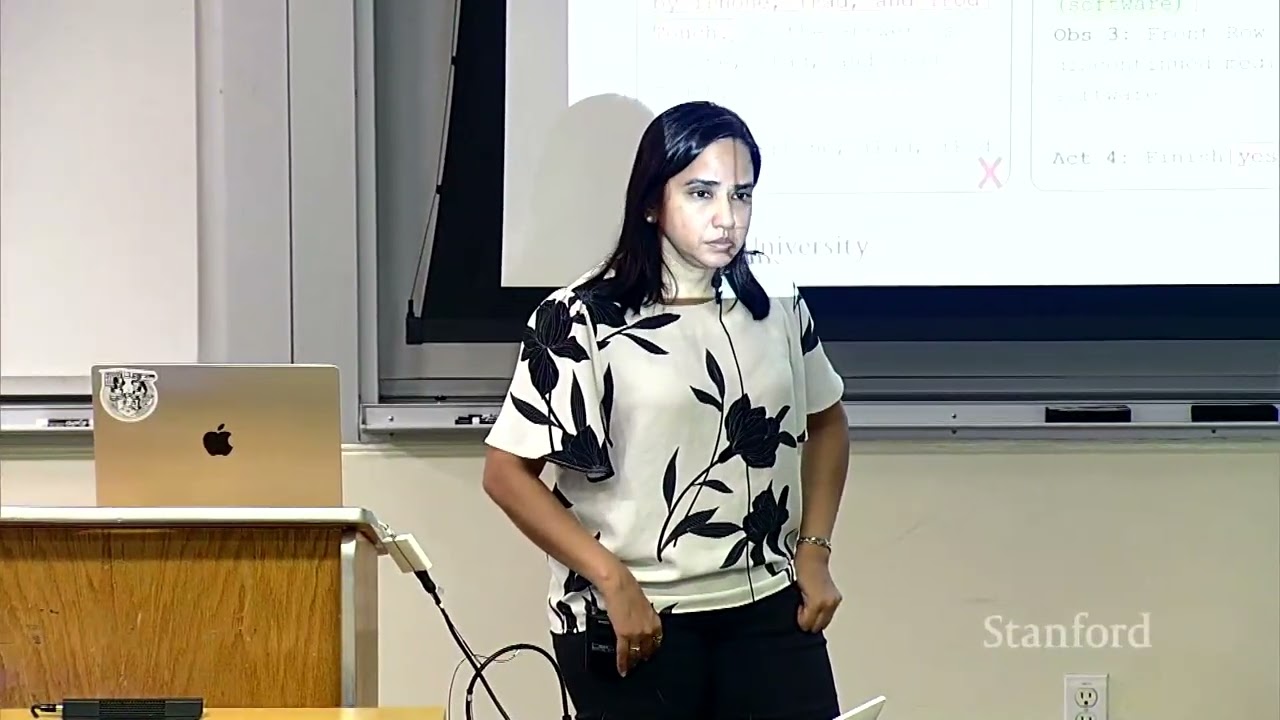
Stanford CS329A Self-Improving AI Agents | Part 1 | Course Overview
Want to dive deeper? This curriculum is covered in the following online courses:- XCS329 graduate course: https://online.stanford.edu/courses/cs329a-self-improving-ai-agents
- Agentic AI professional education program: https://learn.stanford.edu/agentic-ai-2026.html
Follow along with the course schedule and syllabus: https://cs329a.stanford.edu/
View the course playlist: https://www.youtube.com/playlist?list=PLangBM27OtEA
Video Summary:
This first lecture videoof Stanford's CS329A, Self-Improving AI Agents, taught by Aakanksha Chowdhery and Azalia Mirhoseini on September 22, 2025, opens with an overview of scaling laws that link model parameters, training compute, and dataset size to lower test loss in large language models from GPT-2 through GPT-4. It covers few-shot and zero-shot learning, the emergence of chain-of-thought reasoning in larger models, and the role of instruction tuning and reinforcement learning from human feedback in the development of ChatGPT. The lecture introduces inference-time scaling through the Large Language Monkeys project, which repeatedly samples a model's outputs and selects correct answers with a verifier to improve performance without retraining. It then traces the shift from single-turn chatbots to agent workflows such as prompt chaining, routing, parallelization, and orchestrator-worker patterns, using Claude Code and deep research tools as examples. The session closes with logistics for the course.
Speaker Bios:
Aakanksha Chowdhery
Adjunct Professor of Computer Science, Stanford University
Aakanksha is pushing the frontier of agentic LLMs by leveraging RL techniques to enable autonomous self-improving agents, especially in software engineering at the startup Reflection AI. At Stanford, she is co-teaching CS329A (Self-Improving AI agents) in Fall/Winter 2025 and is the Program Chair for MLSys 2026. Before this, she was the technical Lead of 540B PaLM model and lead researcher in Gemini at Google in pre-training, scaling, and finetuning of Large Language Models. She was also a core contributor in PaLM-E, MedPaLM, and Pathways project at Google. Prior to joining Google, she was technical lead for several interdisciplinary research initiatives at Microsoft Research and Princeton University across machine learning and distributed systems. She completed my PhD in Electrical Engineering from Stanford University and was awarded the Paul Baran Marconi Young Scholar Award for the outstanding scientific contributions of her dissertation in the field of communications and Internet.
Azalia Mirhoseini
Assistant Professor of Computer Science, Stanford University
Azalia Mirhoseini is a co-founder of Ricursive Intelligence, a frontier lab dedicated to recursive self-improvement through AI that designs the chips that fuel it. She is also an Assistant Professor of Computer Science at Stanford University where she directs Scaling Intelligence, a lab focused on developing scalable and self-improving AI systems and methodologies toward the goal of artificial general intelligence. Previously, she spent several years in industry AI labs, including Google Brain, Anthropic, and Google DeepMind, working on the development of Claude and Gemini. Her past work includes Mixture-of-Experts (MoE) neural architectures, now predominantly used in leading generative AI models; AlphaChip, a pioneering work on deep reinforcement learning for layout optimization used in the design of advanced chips like Google AI accelerators (TPUs) and data center CPUs; as well as pioneering research on LLM Test-Time Scaling. Her work has been recognized through the Okawa Research Grant, the Google ML and Systems Junior Faculty Award, MIT Technology Review's 35 Under 35 Award, the Best ECE Thesis Award at Rice University, publications in flagship venues such as Nature, and coverage by various media outlets, including WSJ, NYT, Forbes, MIT Technology Review, IEEE Spectrum, WIRED, and TechCrunch. Receive SMS online on sms24.me
TubeReader video aggregator is a website that collects and organizes online videos from the YouTube source. Video aggregation is done for different purposes, and TubeReader take different approaches to achieve their purpose.
Our try to collect videos of high quality or interest for visitors to view; the collection may be made by editors or may be based on community votes.
Another method is to base the collection on those videos most viewed, either at the aggregator site or at various popular video hosting sites.
TubeReader site exists to allow users to collect their own sets of videos, for personal use as well as for browsing and viewing by others; TubeReader can develop online communities around video sharing.
Our site allow users to create a personalized video playlist, for personal use as well as for browsing and viewing by others.
@YouTubeReaderBot allows you to subscribe to Youtube channels.
By using @YouTubeReaderBot Bot you agree with YouTube Terms of Service.
Use the @YouTubeReaderBot telegram bot to be the first to be notified when new videos are released on your favorite channels.
Look for new videos or channels and share them with your friends.
You can start using our bot from this video, subscribe now to Stanford CS329A Self-Improving AI Agents | Part 1 | Course Overview
What is YouTube?
YouTube is a free video sharing website that makes it easy to watch online videos. You can even create and upload your own videos to share with others. Originally created in 2005, YouTube is now one of the most popular sites on the Web, with visitors watching around 6 billion hours of video every month.