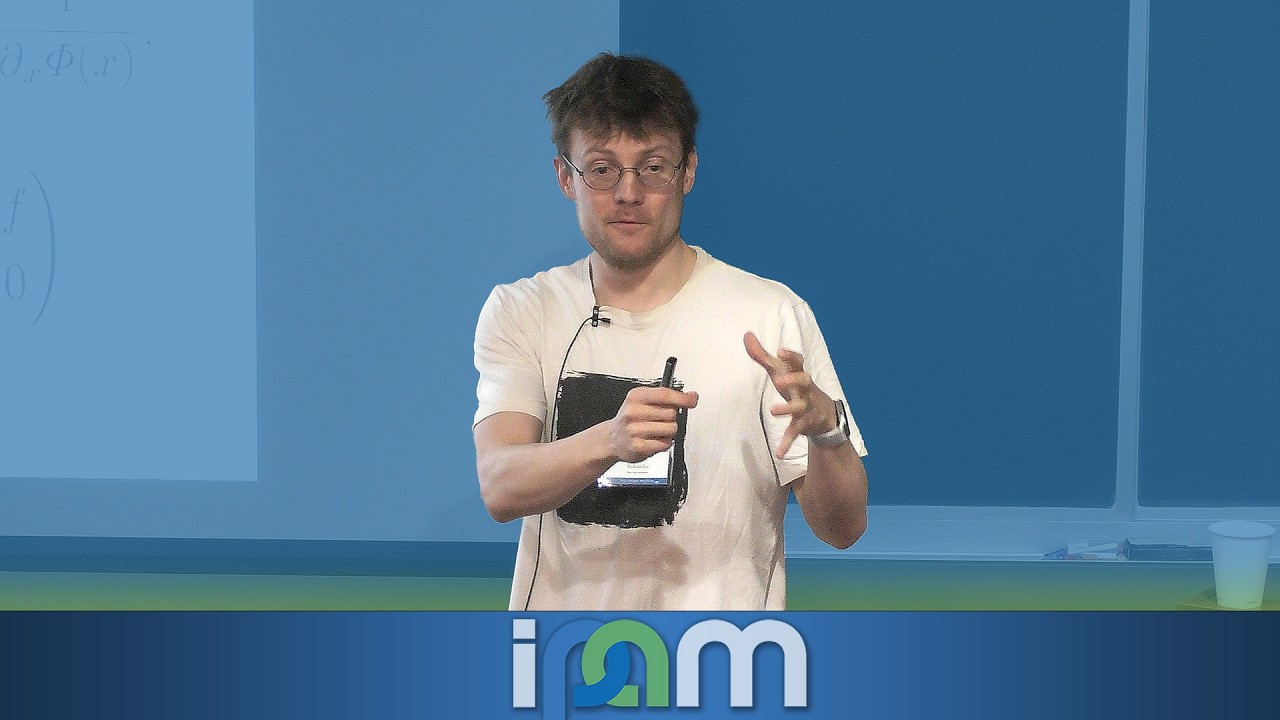
Mark Kostuk - Mixed-Fidelity, Multi-Model Optimization within the DIII-D Digital Twin - IPAM at UCLA
Recorded 18 May 2026. Mark Kostuk of General Atomics presents "Mixed-Fidelity, Multi-Model Optimization within the DIII-D Digital Twin" at IPAM's Multi-Fidelity Methods to Enable Robust Optimization and Real-Time Control of Fusion Processes Workshop.Abstract: The DIII-D National Fusion Facility's digital twin has made significant strides in integrating mixed-fidelity predictive modeling with experimental plasma operations. Currently including physics-based, surrogate ML, and purely data-driven ML models to achieve predictive plasma modeling that combined is of sufficient overall fidelity to influence experimental operations, the digital twin is also platform for optimizing and validating such models. One of the key ongoing challenges remains the integration of models with data to create a continuously updating high-fidelity representation of the experiment. This workshop talk will focus on an essential aspect of this integration: closed-loop model optimization of this mixed-fidelity, multi-model environment.
We will explore two applications of optimization involving the digital twin: model update loops and control parameter selection. The model update loop aims to optimize model parameters to improve predictive simulation accuracy, enabling better experimental design over time. If sufficiently fast, it has the potential for model updates to occur in the context of real-time plasma control. One issue here is that comparison against direct experimental measurements requires progressing through multiple different models. Physical quantities of interest are a natural interface between models yet are unmeasurable internal variables. The digital twin platform aims to allow the user to make the performance-fidelity decision of which model to implement. Control parameter selection seeks to identify optimal settings to achieve target plasma scenarios of the overall experiment. Both applications pose significant challenges due to the need to evaluate performance within an active closed loop through a chain of multiple models. This loop comprises at least the virtual plasma control system and a predictive plasma dynamics model, yet realistically also contains multiple surrogate models covering different experimental aspects and data modalities, therefore care must be taken in how this optimization is performed.
As the workshop is intended for researchers new to these challenges, general concepts, approaches and guiding principles will be described as much as specific results with a goal that everyone can take away useful information to their specific areas of interest.
Acknowledgement: This work was supported under General Atomics’ corporate funds. This material is based upon work supported by the U.S. Department of Energy, Office of Science, Office of Fusion Energy Sciences, using the DIII-D National Fusion Facility, a DOE Office of Science user facility, under Award(s) DE-FC02-04ER54698. An award of computer time was provided by the ASCR Leadership Computing Challenge (ALCC) program. This research used resources of the Argonne Leadership Computing Facility, which is a U.S. Department of Energy Office of Science User Facility operated under contract DE-AC02-06CH11357.
Learn more online at: https://www.ipam.ucla.edu/programs/workshops/workshop-iv-multi-fidelity-methods-to-enable-robust-optimization-and-real-time-control-of-fusion-processes/?tab=overview Receive SMS online on sms24.me
TubeReader video aggregator is a website that collects and organizes online videos from the YouTube source. Video aggregation is done for different purposes, and TubeReader take different approaches to achieve their purpose.
Our try to collect videos of high quality or interest for visitors to view; the collection may be made by editors or may be based on community votes.
Another method is to base the collection on those videos most viewed, either at the aggregator site or at various popular video hosting sites.
TubeReader site exists to allow users to collect their own sets of videos, for personal use as well as for browsing and viewing by others; TubeReader can develop online communities around video sharing.
Our site allow users to create a personalized video playlist, for personal use as well as for browsing and viewing by others.
@YouTubeReaderBot allows you to subscribe to Youtube channels.
By using @YouTubeReaderBot Bot you agree with YouTube Terms of Service.
Use the @YouTubeReaderBot telegram bot to be the first to be notified when new videos are released on your favorite channels.
Look for new videos or channels and share them with your friends.
You can start using our bot from this video, subscribe now to Mark Kostuk - Mixed-Fidelity, Multi-Model Optimization within the DIII-D Digital Twin - IPAM at UCLA
What is YouTube?
YouTube is a free video sharing website that makes it easy to watch online videos. You can even create and upload your own videos to share with others. Originally created in 2005, YouTube is now one of the most popular sites on the Web, with visitors watching around 6 billion hours of video every month.