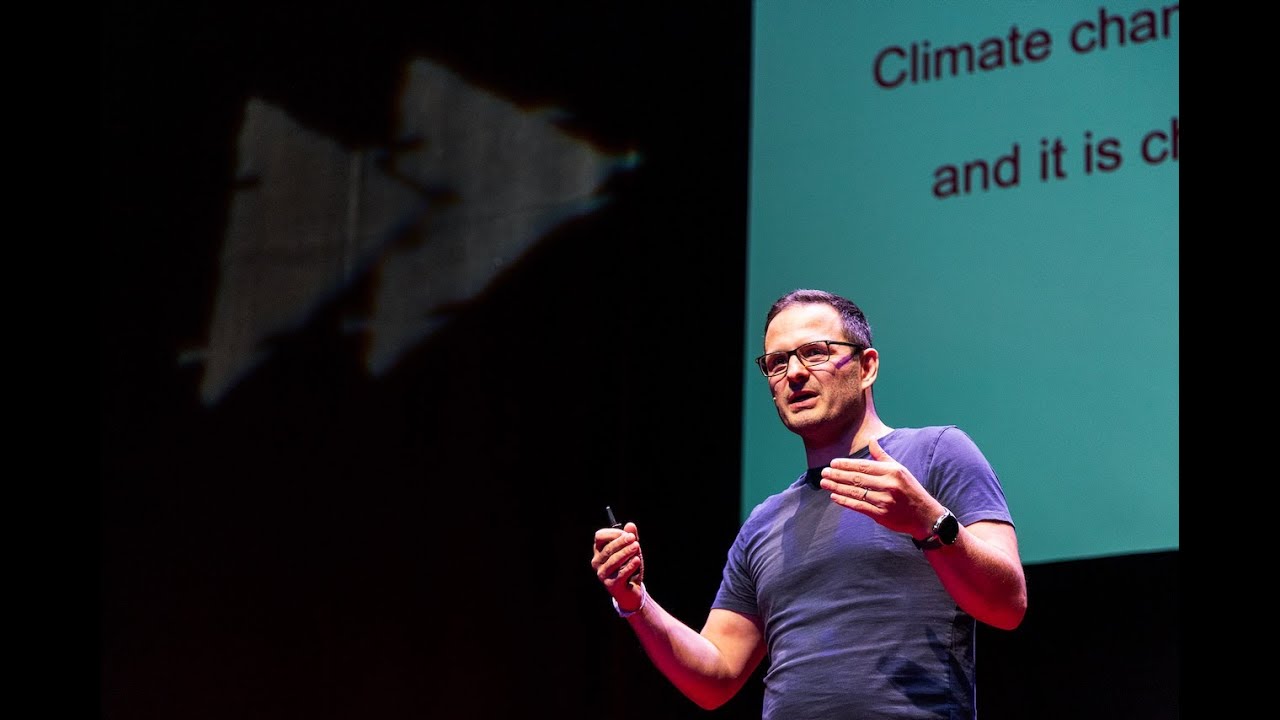
What can bats teach us about building smarter robots? | Rolf Mueller | TEDxMidAtlantic
Robots in factories can afford to be stupid — we built a perfectly controlled world around them. Take one outside, into a forest or a field or "national security out in the dirt," and it falls apart. Rolf Mueller's work lives at that frontier: machines that have to be both genuinely nimble and genuinely smart in the messy real world. The catch is that fusing a capable body to a capable brain means searching a space so vast no supercomputer can brute-force it. His cheeky solution is intellectual-property theft — steal the answers from the one entity that already ran the search for billions of years: evolution.The thief's target is the bat. Mueller makes the case that bats are little superheroes carrying exactly the powers autonomy demands — sonar that brings its own light into total darkness, and powered flight no other mammal has — which is why more than one in five mammal species is a bat. But the detail that should stop you is how cheaply nature pulled it off. A bat matures in under a month on less biosonar data than you burn through your phone in a month, while training one outdated chatbot reportedly took thousands of times more. If we don't learn that kind of frugality, he warns, we'll drain the planet's power just to train chatbots — while a creature that hunts through the jungle with its eyes closed runs on almost nothing.
Then he shows what his lab has actually built — and where it's headed. The talk earns one of the strangest closing images you'll see on a TEDx stage: a "robot breeding program." Watch to find out what gets bred, and why marrying a smart brain to a nimble body might be the only honest path to machines that can survive outside the lab. Rolf Mueller is the Raymond E. and Shirley B. Lynn Professor of Mechanical Engineering at Virginia Tech, and the Director of the Bioinspired Science and Technology Center.
Rolf Mueller's group seeks to develop robots that can mimic the superior sensing abilities and mobility of bats that are able to hunt in dense natural environments. Bats have the most complicated flight apparatus across all biological and engineered systems that fly with about 20 discrete degrees of freedom in each wing. Similarly to the complexity of the wings, bats have about 20 muscles on each ear that deform the shape of the pinna as it diffracts the incoming biosonar echoes. Biomimetic reproductions are an important tools for understanding these complex mechanical systems for mobility and sensing.
Bats live in complex environments and hence receive complex ultrasonic echoes that are superpositions of contributions from many reflecting facets (e.g., leaves in a foliage). Such "clutter echoes" have eluded interpretation in technical sonar for many decades. However, the ongoing revolution in the capabilities of deep-learning methods provide a unique opportunity to extract patterns from data that have previously resisted interpretation. Mueller's group is exploiting deep-learning methods to extract valuable information on complex environments from these "clutter echoes". Furthermore, the research employs transparent AI approaches to gain insight into what the informative signal features. Based on these insights, highly efficient neuromorphic approaches to extracting sensory information can be implemented. To tie sensing and robotics, Mueller's group is working on deep reinforcement learning methods that can integrate the control of the complex soft-robotic ears with the sensing. This talk was given at a TEDx event using the TED conference format but independently organized by a local community. Learn more at https://www.ted.com/tedx Receive SMS online on sms24.me
TubeReader video aggregator is a website that collects and organizes online videos from the YouTube source. Video aggregation is done for different purposes, and TubeReader take different approaches to achieve their purpose.
Our try to collect videos of high quality or interest for visitors to view; the collection may be made by editors or may be based on community votes.
Another method is to base the collection on those videos most viewed, either at the aggregator site or at various popular video hosting sites.
TubeReader site exists to allow users to collect their own sets of videos, for personal use as well as for browsing and viewing by others; TubeReader can develop online communities around video sharing.
Our site allow users to create a personalized video playlist, for personal use as well as for browsing and viewing by others.
@YouTubeReaderBot allows you to subscribe to Youtube channels.
By using @YouTubeReaderBot Bot you agree with YouTube Terms of Service.
Use the @YouTubeReaderBot telegram bot to be the first to be notified when new videos are released on your favorite channels.
Look for new videos or channels and share them with your friends.
You can start using our bot from this video, subscribe now to What can bats teach us about building smarter robots? | Rolf Mueller | TEDxMidAtlantic
What is YouTube?
YouTube is a free video sharing website that makes it easy to watch online videos. You can even create and upload your own videos to share with others. Originally created in 2005, YouTube is now one of the most popular sites on the Web, with visitors watching around 6 billion hours of video every month.