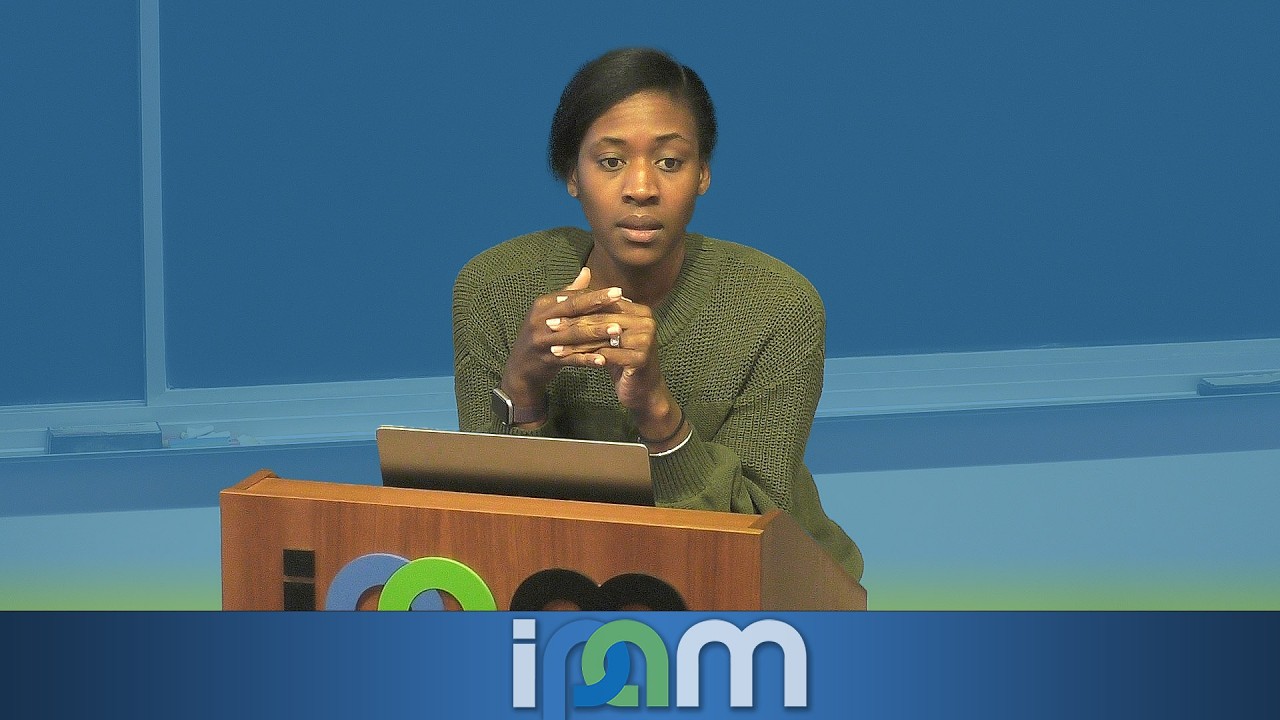
Renee Brady-Nicholls - Developing Predictive Models Using Minimally-Invasive Biomarkers, Pt. 1/2
Recorded 23 February 2026. Renee Brady-Nicholls of Moffitt Cancer Center & Research Institute presents "Developing Predictive Models Using Minimally-Invasive Biomarkers, Pt. 1/2" at IPAM's Mathematics of Cancer: Open Mathematical Problems Workshop.Abstract: Predictive models transform patient biomarker measurements into dynamic forecasts of disease and treatment response, enabling clinically actionable prediction rather than retrospective description. While invasive biomarkers—such as tissue biopsies, surgical pathology specimens, and cerebrospinal fluid sampling—provide rich biological detail, they are costly, risky, and sparsely collected, limiting their utility for longitudinal modeling. In contrast, minimally- and non-invasive biomarkers, including liquid biopsy measures and patient-reported outcomes (PROs), can be collected frequently with low patient burden, making them well-suited for dynamic prediction despite their lower biological resolution. Incorporating these data into predictive mathematical frameworks can present key modeling challenges, including noisy measurements, indirect observability of disease state, and inter-patient heterogeneity. Assessing a model’s predictive ability requires careful consideration of these potential issues. In this talk, we demonstrate how PRO data collected biweekly from non–small cell lung cancer patients receiving immunotherapy can be integrated into a calibrated and validated predictive model to forecast volumetric disease progression and generate patient-specific predictions. We conclude by highlighting practical modeling challenges, such as working with noisy and incomplete longitudinal data and balancing biological realism with mathematical tractability and discuss strategies for addressing these challenges in predictive oncology models.
Learn more online at: https://www.ipam.ucla.edu/programs/workshops/mathematics-of-cancer-open-mathematical-problems/ Receive SMS online on sms24.me
TubeReader video aggregator is a website that collects and organizes online videos from the YouTube source. Video aggregation is done for different purposes, and TubeReader take different approaches to achieve their purpose.
Our try to collect videos of high quality or interest for visitors to view; the collection may be made by editors or may be based on community votes.
Another method is to base the collection on those videos most viewed, either at the aggregator site or at various popular video hosting sites.
TubeReader site exists to allow users to collect their own sets of videos, for personal use as well as for browsing and viewing by others; TubeReader can develop online communities around video sharing.
Our site allow users to create a personalized video playlist, for personal use as well as for browsing and viewing by others.
@YouTubeReaderBot allows you to subscribe to Youtube channels.
By using @YouTubeReaderBot Bot you agree with YouTube Terms of Service.
Use the @YouTubeReaderBot telegram bot to be the first to be notified when new videos are released on your favorite channels.
Look for new videos or channels and share them with your friends.
You can start using our bot from this video, subscribe now to Renee Brady-Nicholls - Developing Predictive Models Using Minimally-Invasive Biomarkers, Pt. 1/2
What is YouTube?
YouTube is a free video sharing website that makes it easy to watch online videos. You can even create and upload your own videos to share with others. Originally created in 2005, YouTube is now one of the most popular sites on the Web, with visitors watching around 6 billion hours of video every month.