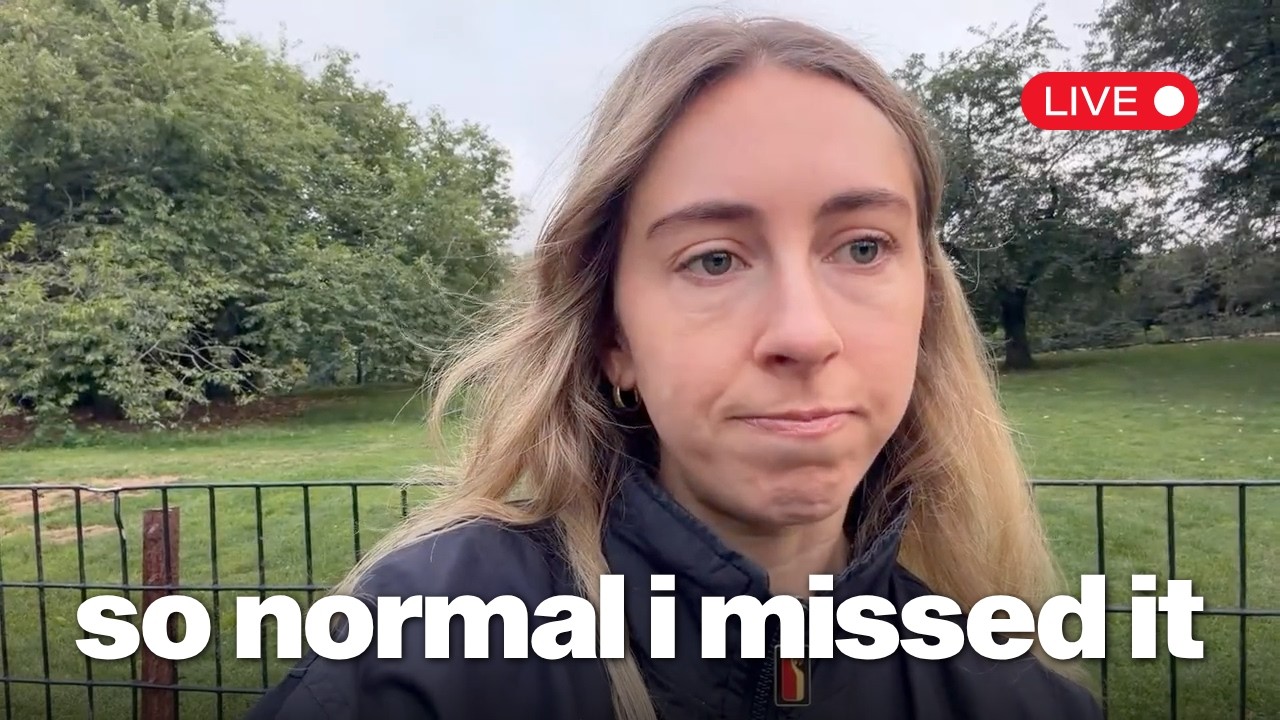
How to fix your product roadmap — Matt Feczko (Director of Product Ops, Ocado Technology)
Matt Feczko is director of product operations at Ocado, the UK grocery technology company whose warehouse robots and delivery automation now run for retailers including Kroger in the US and Coles in Australia. He spent the first half of his career as a customer-facing product manager, starting on SharePoint and Office at Microsoft before moving to the UK to join Skype and then four different startups over six years. A LinkedIn recruiter's typo — dropping a comma from his job title — led him to Ocado three and a half years ago, where his remit has since expanded to cover both product and engineering operations. Talking to host Randy Silver backstage at MTPcon London, he explains how he replaced Ocado's roadmap planning process, rebuilt its Jira taxonomy from scratch, and built a product management skills framework that other functions have since copied without being asked.Key takeaways
Ocado's roadmap problem wasn't a lack of roadmaps, it was too many of them, rebuilt by hand every quarter. Before Feczko joined, product teams spent two months of every three-month cycle remaking roadmap slides in Google Slides, with no shared document explaining what the company was building or why, and no way for anyone outside the planning meetings to weigh in.
He traced that chaos to a single root cause: an inconsistent Jira taxonomy. Different teams used "epics" to mean different things, some nesting parent epics inside parent epics, so there was no agreed definition of what a feature or an initiative actually was. Feczko fixed the hierarchy first, using Denise Tilles and Melissa Perri's book Product Operations as his reference, before touching the roadmap process at all — his team nicknamed the project the "Jira Revolution".
The hard part wasn't designing the new structure, it was getting roughly 3,000 developers to adopt it. Feczko frames that adoption problem as the actual job of product operations: not producing an artefact, but changing how a large organisation works, thinks and describes its own output.
Two years on, Ocado has replaced its quarterly roadmap slide decks with an internal app, built on top of Jira data, and Feczko is aiming to run the next planning cycle with zero slides. His team also worked with finance to translate operational metrics — such as items added per basket, or driver deliveries per shift — into the financial value each initiative is expected to produce, so planning conversations use the same language as the business case.
To answer a question Ocado's product managers couldn't answer for themselves — what "good" looks like in the role — Feczko built a 12-skill framework across four themes, including execution, influence and strategy. He combined an existing Reforge framework with his CPO's own view of the job and his own 15 years of experience, then spent six months negotiating the exact wording with the wider team before any of it shipped.
The skill Feczko insisted on calling "storytelling and evangelising", over his CPO's preferred "effective communication", has become the framework's anchor. His argument: the ability to tell a clear story about a product is itself evidence of every other skill, because it requires command of the data, a defined strategy and the ability to prioritise.
The framework's real test came when other functions adopted it unprompted. Engineering, roughly 2,000 people, built its own version, as did design and data — keeping Feczko's four themes but writing skill definitions specific to each craft. That took total usage from around 150 product people to roughly 3,000 across the wider organisation.
One skill, product adoption, was added specifically because Ocado's product managers didn't see driving adoption as part of their job — they considered their job done once a feature shipped, and expected the business to work out how to use it. Feczko flags this as a gap worth checking for in any company's own skills work, whatever it ends up being called: he expects most will need their own version, along the lines of "value realisation".
Feczko's rule of thumb for when a company needs a dedicated product operations function is somewhere around 30 to 40 product managers, though he says the pressure shows up earlier: even at 10 people split across teams, a cross-functional roadmap with real dependencies is where the gap first becomes visible.
Asked what to do first, his advice is to resist fixing everything at once. Product operations, he says, is the "connective tissue" of an organisation: find where there's tension, solve that one problem fully, then move to the next — because switching between half-solved problems just turns the job into whack-a-mole.
Chapters
(00:00) Slides are dead for product planning
(00:26) Backstage at MTPcon London
(00:49) From computer science nerd to Microsoft PM
(02:02) The Skype mafia
(02:58) What Ocado actually builds
(04:38) How a LinkedIn typo led to Ocado's product ops job
(07:14) The minimum viable bureaucracy problem Receive SMS online on sms24.me
TubeReader video aggregator is a website that collects and organizes online videos from the YouTube source. Video aggregation is done for different purposes, and TubeReader take different approaches to achieve their purpose.
Our try to collect videos of high quality or interest for visitors to view; the collection may be made by editors or may be based on community votes.
Another method is to base the collection on those videos most viewed, either at the aggregator site or at various popular video hosting sites.
TubeReader site exists to allow users to collect their own sets of videos, for personal use as well as for browsing and viewing by others; TubeReader can develop online communities around video sharing.
Our site allow users to create a personalized video playlist, for personal use as well as for browsing and viewing by others.
@YouTubeReaderBot allows you to subscribe to Youtube channels.
By using @YouTubeReaderBot Bot you agree with YouTube Terms of Service.
Use the @YouTubeReaderBot telegram bot to be the first to be notified when new videos are released on your favorite channels.
Look for new videos or channels and share them with your friends.
You can start using our bot from this video, subscribe now to How to fix your product roadmap — Matt Feczko (Director of Product Ops, Ocado Technology)
What is YouTube?
YouTube is a free video sharing website that makes it easy to watch online videos. You can even create and upload your own videos to share with others. Originally created in 2005, YouTube is now one of the most popular sites on the Web, with visitors watching around 6 billion hours of video every month.