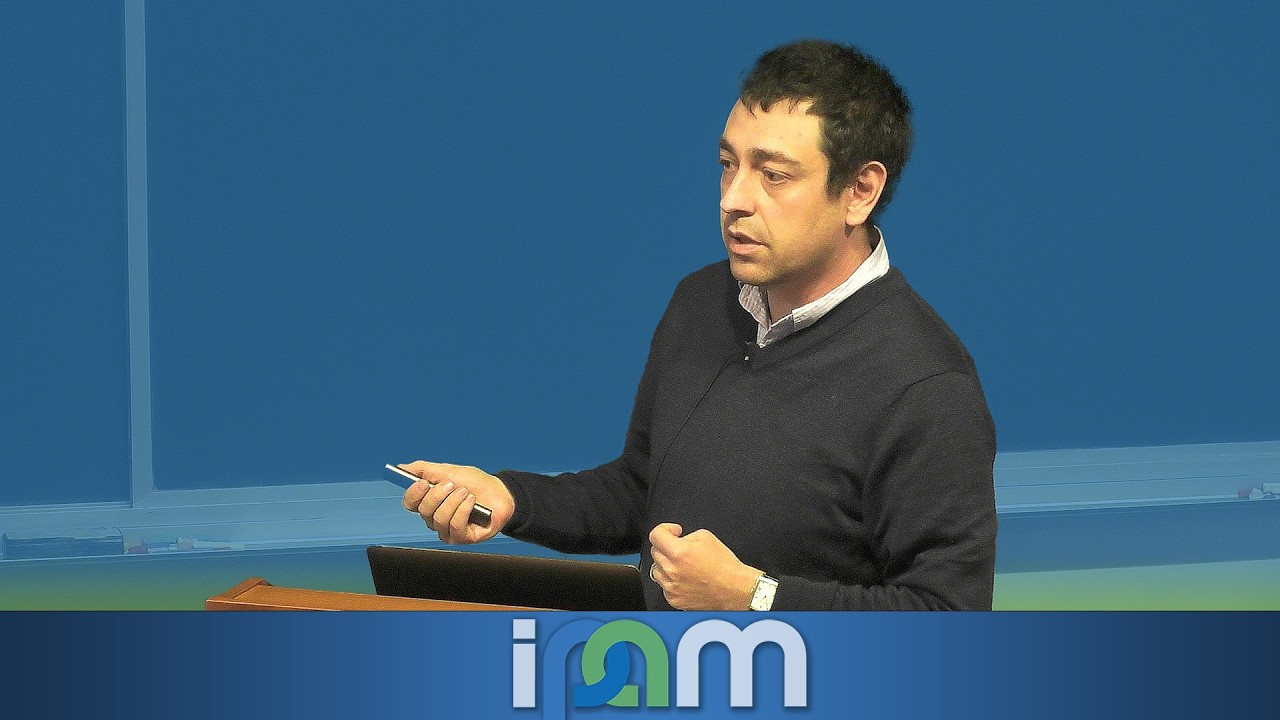
David Hatch - Bridging the pedestal gap: intermediate-fidelity models for pedestal transport
Recorded 25 March 2026. David Hatch of the University of Texas at Austin presents "Bridging the pedestal gap: intermediate-fidelity models for pedestal transport" at IPAM's Multi-Fidelity Methods for Fusion Plasma Physics Workshop.Abstract: The projected cost of a magnetic confinement fusion power plant is strongly dependent on the level of plasma confinement that it can achieve. Confinement in tokamaks is largely determined by the quality of the edge ‘transport barrier’, called the pedestal. This is typically quantified by the pressure at the inner boundary of the pedestal, which effectively acts as a boundary condition for the bulk of the plasma. Despite the well-known causal relation between pedestal pressure and confinement, predictive capability remains limited when projecting performance in future devices. The two main approaches span the extremes of the fidelity hierarchy—from semi-empirical MHD-based models to high fidelity full-f gyrokinetics—but they leave much to be desired in terms of rigorous validation, breadth of applicability, and/or simulation cost. Though the ‘extremes’ are covered, there exists a gap—a potential sweet spot—in the middle for models that capture more physics than the lower fidelity options and retain the efficiency lacking at higher fidelity. Moreover, fast surrogate models can be applied to powerful optimization, control, or UQ workflows. This presentation will describe these ‘intermediate’ fidelity transport models for pedestal transport, their development and validation within a Bayesian framework, and outlook on future directions, including promising multi-fidelity applications.
Learn more online at: https://www.ipam.ucla.edu/programs/workshops/workshop-i-multi-fidelity-methods-for-fusion-plasma-physics/?tab=overview Receive SMS online on sms24.me
TubeReader video aggregator is a website that collects and organizes online videos from the YouTube source. Video aggregation is done for different purposes, and TubeReader take different approaches to achieve their purpose.
Our try to collect videos of high quality or interest for visitors to view; the collection may be made by editors or may be based on community votes.
Another method is to base the collection on those videos most viewed, either at the aggregator site or at various popular video hosting sites.
TubeReader site exists to allow users to collect their own sets of videos, for personal use as well as for browsing and viewing by others; TubeReader can develop online communities around video sharing.
Our site allow users to create a personalized video playlist, for personal use as well as for browsing and viewing by others.
@YouTubeReaderBot allows you to subscribe to Youtube channels.
By using @YouTubeReaderBot Bot you agree with YouTube Terms of Service.
Use the @YouTubeReaderBot telegram bot to be the first to be notified when new videos are released on your favorite channels.
Look for new videos or channels and share them with your friends.
You can start using our bot from this video, subscribe now to David Hatch - Bridging the pedestal gap: intermediate-fidelity models for pedestal transport
What is YouTube?
YouTube is a free video sharing website that makes it easy to watch online videos. You can even create and upload your own videos to share with others. Originally created in 2005, YouTube is now one of the most popular sites on the Web, with visitors watching around 6 billion hours of video every month.