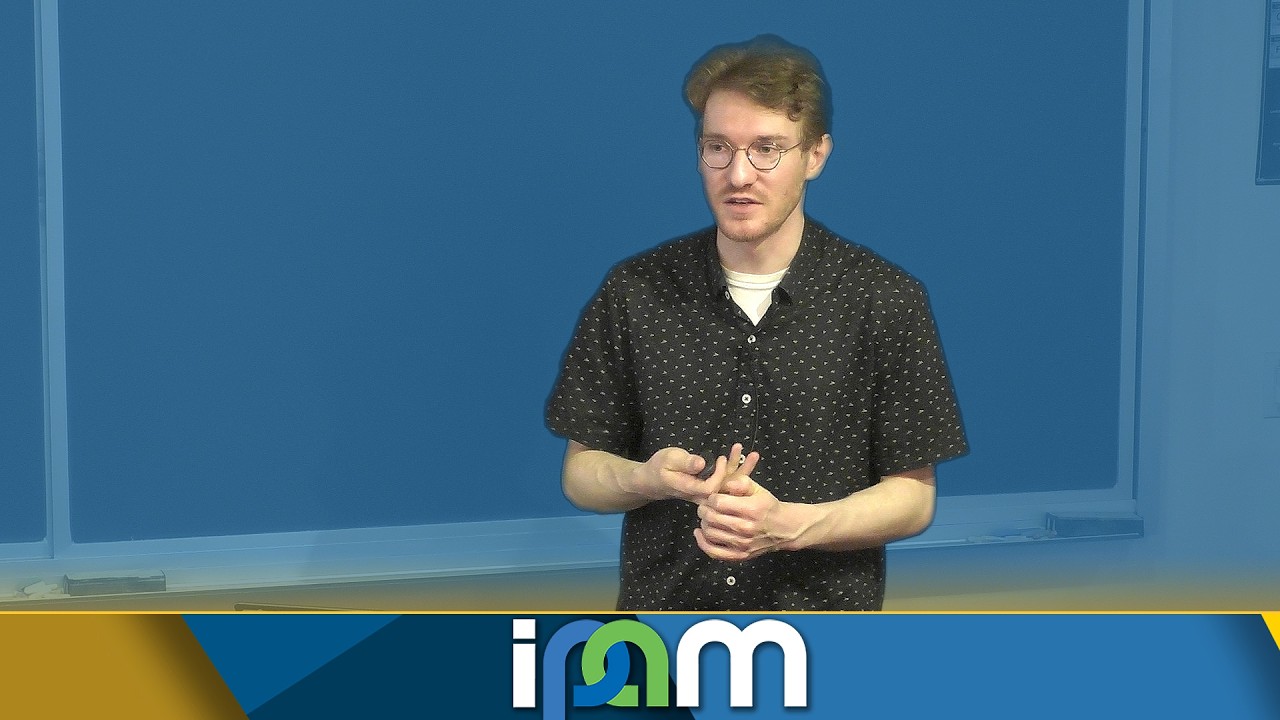
Allison Baker - Is it still correct? Quality assurance for an Earth System Model - IPAM at UCLA
Recorded 17 September 2026. Allison Baker of the National Center for Atmospheric Research presents "Is it still correct? Quality assurance for an Earth System Model" at IPAM's PDEs: Verification, Mathematics, and Algorithms in the Age of AI workshop.Abstract: Earth System Models are large, complex, and continually evolving. How do we know the model's results can still be trusted after a minor change, such as a new hardware platform, a compiler update, or a refactored subroutine?
Earth System Models are valuable for understanding past and present climates and are vital for addressing otherwise intractable questions about future climate scenarios. Because the simulation output may affect societal responses to a changing climate, maintaining model confidence and reliability is critical for institutions such as the National Center for Atmospheric Research, which leads the development of the popular Community Earth System Model (CESM). CESM models the Earth system by simulating the major Earth system components (e.g., atmosphere, ocean, land, river, ice, etc.) and the interactions between them. These processes result in a complex multi-physics model that is inherently chaotic, where even seemingly inconsequential factors, such as changes to the hardware or software stack, can cause large effects. This sensitivity, compounded by a vast, complex, and continually evolving code base, means that ensuring quality assurance is non-trivial, as requiring bitwise identical results is not feasible. This talk will overview our multi-year effort to evaluate "correctness" in CESM, including the challenges encountered and the effectiveness in practice of an ensemble-based testing approach that casts correctness in terms of statistical distinguishability.
Learn more online at: https://www.ipam.ucla.edu/programs/workshops/pdes-verification-mathematics-and-algorithms-in-the-age-of-ai/?tab=overview Receive SMS online on sms24.me
TubeReader video aggregator is a website that collects and organizes online videos from the YouTube source. Video aggregation is done for different purposes, and TubeReader take different approaches to achieve their purpose.
Our try to collect videos of high quality or interest for visitors to view; the collection may be made by editors or may be based on community votes.
Another method is to base the collection on those videos most viewed, either at the aggregator site or at various popular video hosting sites.
TubeReader site exists to allow users to collect their own sets of videos, for personal use as well as for browsing and viewing by others; TubeReader can develop online communities around video sharing.
Our site allow users to create a personalized video playlist, for personal use as well as for browsing and viewing by others.
@YouTubeReaderBot allows you to subscribe to Youtube channels.
By using @YouTubeReaderBot Bot you agree with YouTube Terms of Service.
Use the @YouTubeReaderBot telegram bot to be the first to be notified when new videos are released on your favorite channels.
Look for new videos or channels and share them with your friends.
You can start using our bot from this video, subscribe now to Allison Baker - Is it still correct? Quality assurance for an Earth System Model - IPAM at UCLA
What is YouTube?
YouTube is a free video sharing website that makes it easy to watch online videos. You can even create and upload your own videos to share with others. Originally created in 2005, YouTube is now one of the most popular sites on the Web, with visitors watching around 6 billion hours of video every month.