Red lines and realities: Why the US-Iran peace talks in Islamabad collapsed | This is America
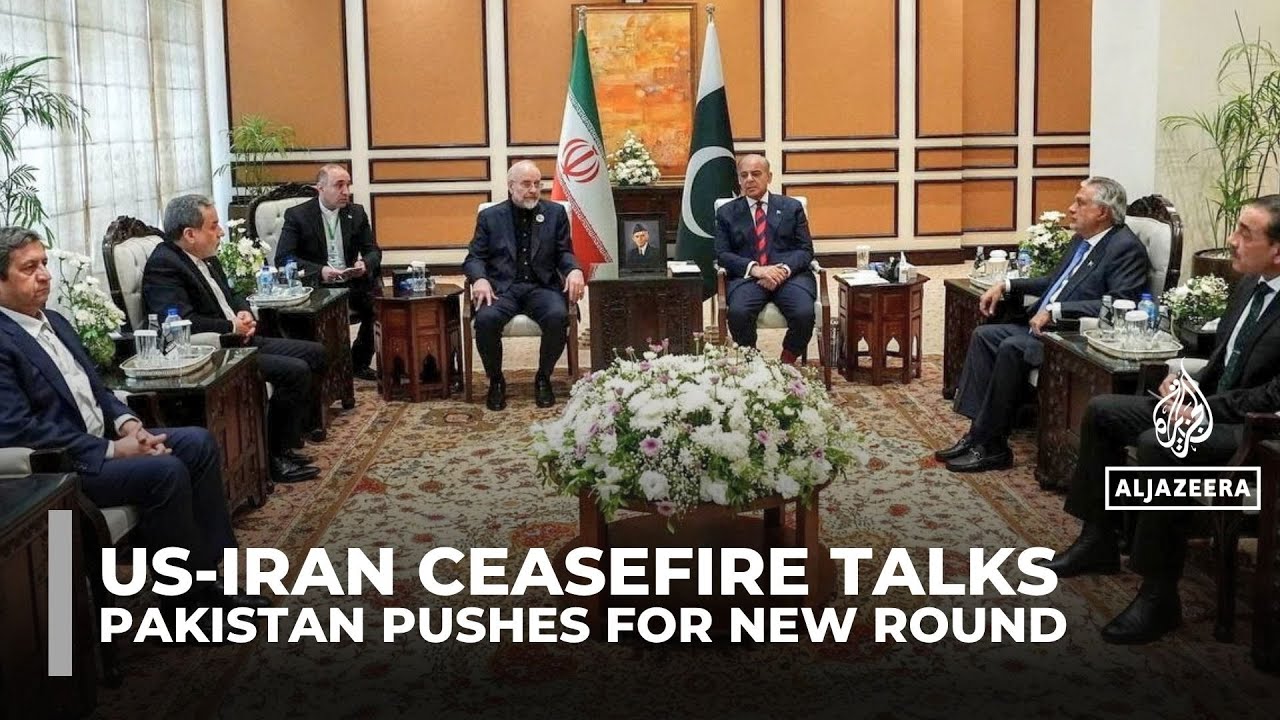
In this episode of This is America, hosted by Anna Burns‑Francis, Al Jazeera examines why high‑level US–Iran peace talks in Islamabad collapsed after 21 hours, and how rival red lines over nuclear power, regional influence and control of the Strait of Hormuz now threaten a fragile ceasefire. From our Washington, DC bureau to the White House, the programme asks what a global superpower is really showing the world about consistency and stability as US negotiators return home empty‑handed and President Donald Trump responds by ordering a naval blockade on Iran’s main energy lifeline.We break down the clash at the negotiating table in Pakistan. On the US side, Vice President JD Vance insists Iran “has chosen not to accept our terms”. Washington’s priorities are clear: a permanent ban on Iranian nuclear weapons, the elimination or export of enriched uranium, an end to uranium enrichment inside Iran, guaranteed freedom of navigation through the Strait of Hormuz, curbs on ballistic missiles and a halt to support for armed groups across the region. Across the table, Iran’s parliamentary speaker Mohammad Bagher Ghalibaf says Tehran brings “goodwill and intent” but “does not trust the other side” after two recent wars, and will not surrender what it sees as sovereign rights – including enrichment for civilian use, non‑negotiable missile capabilities, sanctions relief and effective control over Hormuz.
From the White House, Alan Fisher explains how Trump’s “all or none” blockade aims to stop Iran charging tolls or taking untraceable cryptocurrency payments from ships, throttle its access to hard currency, and use the strait – once the route for 20 percent of global oil trade – to strip away Iran’s key source of leverage. We examine how this strategy fits a long‑running pattern: a high‑pressure, deadline‑driven style rooted in New York real estate and echoes of the “madman theory”, from threats to “end a civilisation” to warnings of “lethal prosecution and destruction” if no “real agreement” is reached before the ceasefire runs out in nine days.
In the studio, former US Ambassador and Assistant Secretary of State for Near Eastern Affairs Jeffrey Feltman and former senior CIA analyst John Nixon join Anna Burns‑Francis to assess how far apart the two sides remain and why the talks were always unlikely to solve decades‑old disputes in less than a day. They explore the diplomatic puzzle of reconciling a US demand for zero enrichment with Iran’s insistence on its nuclear “rights”, the gap between US claims of having “obliterated” Iran’s military capacity and the reality that missiles and nuclear know‑how can be rebuilt, and whether Tehran’s time‑buying tactics – haggling to the last minute and trying to exhaust its opponent – are again paying off.
Heidi Zhou‑Castro charts the domestic fallout, from gloomy “no deal” headlines that hit before Vance landed back in Washington to partisan TV interviews framing the US–Iran war as either necessary pressure or an unauthorised, strategy‑free conflict. She reports on growing concern that a “blockade of a blockade” could drag in more countries, rattle global energy markets and push fuel prices higher for American households.
Finally, Alex Baird rounds out the programme with the online battle over what happens next – tracking how a now‑deleted Christlike image of the president, conspiracy‑minded calls for him to “wake up” and make a different deal with Iran, and conservative praise for a supposed “reverse UNO card” collide with criticism of Trump’s weekend at a UFC fight and warnings that maximalist demands could lock both sides into a prolonged test of endurance.
This is America asks whether there is still room to renegotiate each side’s “non‑negotiables” – or whether the red lines drawn in Islamabad and on the waters of Hormuz are now too deep to erase.
Subscribe to our channel: http://bit.ly/AJSubscribe
Follow us on X: https://twitter.com/AJEnglish
Find us on Facebook: https://www.facebook.com/aljazeera
Check our website: http://www.aljazeera.com/
Check out our Instagram page: https://www.instagram.com/aljazeeraenglish/
Download AJE Mobile App: https://aje.news/AJEMobile
#US #Iran #USIranTalks #USIranCeasefire #DonaldTrump #StraitOfHormuz #Israel #USIsraelWarOnIran #IranWar #IranConflict #IRGC #RegimeChange #MiddleEast #OperationEpicFury #AlJazeeraEnglish Receive SMS online on sms24.me
TubeReader video aggregator is a website that collects and organizes online videos from the YouTube source. Video aggregation is done for different purposes, and TubeReader take different approaches to achieve their purpose.
Our try to collect videos of high quality or interest for visitors to view; the collection may be made by editors or may be based on community votes.
Another method is to base the collection on those videos most viewed, either at the aggregator site or at various popular video hosting sites.
TubeReader site exists to allow users to collect their own sets of videos, for personal use as well as for browsing and viewing by others; TubeReader can develop online communities around video sharing.
Our site allow users to create a personalized video playlist, for personal use as well as for browsing and viewing by others.
@YouTubeReaderBot allows you to subscribe to Youtube channels.
By using @YouTubeReaderBot Bot you agree with YouTube Terms of Service.
Use the @YouTubeReaderBot telegram bot to be the first to be notified when new videos are released on your favorite channels.
Look for new videos or channels and share them with your friends.
You can start using our bot from this video, subscribe now to Red lines and realities: Why the US-Iran peace talks in Islamabad collapsed | This is America
What is YouTube?
YouTube is a free video sharing website that makes it easy to watch online videos. You can even create and upload your own videos to share with others. Originally created in 2005, YouTube is now one of the most popular sites on the Web, with visitors watching around 6 billion hours of video every month.