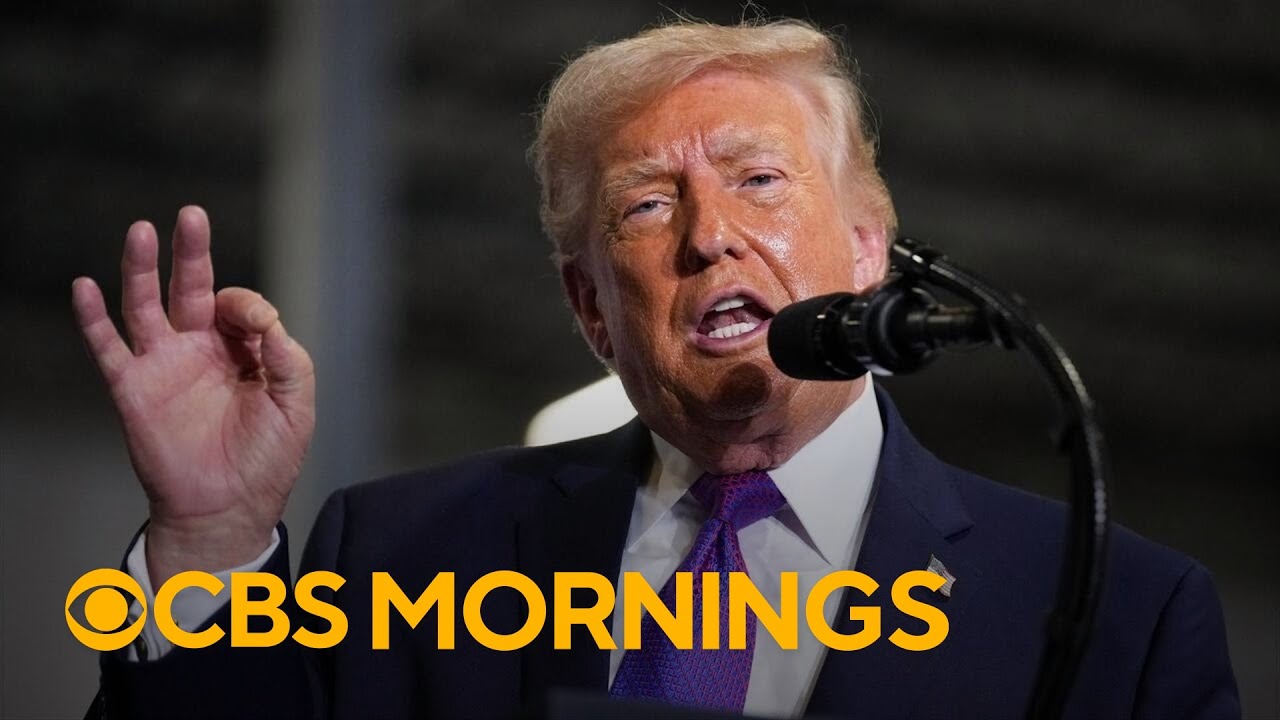
😎 Keynes tenía razón ❗👏 El tipo de interés de la deuda pública lo decide el Estado, no el mercado!💰
Keynes tenía razón: el tipo de interés de la deuda pública no lo decide el mercado, sino el Estado! Esto significa que los inversores financieros no pueden chantajear a ningún gobierno.✊ Puedes apoyar al canal, participar en él y disfrutar de ventajas exclusivas haciéndote miembro (dándole al botón "Unirme" o pinchando aquí: https://www.youtube.com/channel/UCtHZcKdtYmOAU-0lsE_iAkA/join). El apoyo económico sólo se utiliza para promocionar el canal.
📸 Instagram https://www.instagram.com/edugaresp/
📱 Tiktok https://www.tiktok.com/@edugaresp88
🐦 Twitter https://twitter.com/edugaresp
📘 Facebook https://www.facebook.com/eduardo.g.espinosa
💙Bluesky https://bsky.app/profile/edugaresp.bsky.social
🟢 Spotify https://open.spotify.com/show/6qhveG8udiopCvD41q2P3c
🔶 Ivoox https://www.ivoox.com/podcast-eduardo-garzon-espinosa_sq_f11640112_1.html
Riefler, W. W. 1930. Money Rates and Money Markets in the United States. New York, NY: Harper & Brothers
Keynes, J. M. 1930. A Treatise on Money, Vol. II: The Applied Theory of Money. London: Macmillan.
Das, A., and T. Akram. 2020. “Keynesian Analysis of Canadian Government Securities Yields.” PSL Quarterly Review 73(294): 241–60.
An Empirical Analysis of Swedish Government Bond Yields https://www.levyinstitute.org/wp-content/uploads/2025/03/wp_1048.pdf
Akram, T. 2022. “Multifactor Keynesian Models of the Long-Term Interest Rate.” Applied Economics Letters 30(9): 1222–27. https://www.tandfonline.com/doi/full/10.1080/13504851.2022.2041174
Akram, T., and A. Das. 2017. “The Dynamics of Government Bond Yields in the Eurozone.” Annals of Financial Economics 12 (3): 1750011–1750018. September. doi:10.1142/S2010495217500117.
Akram, T., and H. Li. 2020a. “An Inquiry Concerning Long-Term U.S. Interest Rates Using Monthly Data.” Applied Economics 52 (24): 2594–2621. doi:10.1080/ 00036846.2019.1693696. https://www.levyinstitute.org/pubs/wp_894.pdf
Akram, T., and H. Li. 2020b. “JGBs’ Chronically Low Nominal Yields: A VEC Approach.” Applied Economics 52 (53): 5873–5893. doi:10.1080/00036846.2020.1776838https://sci-hub.st/10.1080/00036846.2020.1776838
Akram, T., and H. Li. 2020c. “The Empirics of UK Gilts’ Yields.” Levy Institute Working Paper, No. 969. http:// www.levyinstitute.org/pubs/wp_969.pdf
Akram, T., and S. A. H. Uddin. 2022. “The Empirics of LongTerm Mexican Government Bond Yields.”Macroeconomics and Finance in Emerging Market Economies: 1–23. (available online first). doi:10.1080/17520843.2021.2022875. Receive SMS online on sms24.me
TubeReader video aggregator is a website that collects and organizes online videos from the YouTube source. Video aggregation is done for different purposes, and TubeReader take different approaches to achieve their purpose.
Our try to collect videos of high quality or interest for visitors to view; the collection may be made by editors or may be based on community votes.
Another method is to base the collection on those videos most viewed, either at the aggregator site or at various popular video hosting sites.
TubeReader site exists to allow users to collect their own sets of videos, for personal use as well as for browsing and viewing by others; TubeReader can develop online communities around video sharing.
Our site allow users to create a personalized video playlist, for personal use as well as for browsing and viewing by others.
@YouTubeReaderBot allows you to subscribe to Youtube channels.
By using @YouTubeReaderBot Bot you agree with YouTube Terms of Service.
Use the @YouTubeReaderBot telegram bot to be the first to be notified when new videos are released on your favorite channels.
Look for new videos or channels and share them with your friends.
You can start using our bot from this video, subscribe now to 😎 Keynes tenía razón ❗👏 El tipo de interés de la deuda pública lo decide el Estado, no el mercado!💰
What is YouTube?
YouTube is a free video sharing website that makes it easy to watch online videos. You can even create and upload your own videos to share with others. Originally created in 2005, YouTube is now one of the most popular sites on the Web, with visitors watching around 6 billion hours of video every month.

![Хованский и Дмитрий Дибров [БОЛЬШОЙ РАЗГОВОР]](https://img.youtube.com/vi/FY7p60Apt4g/maxresdefault.jpg)