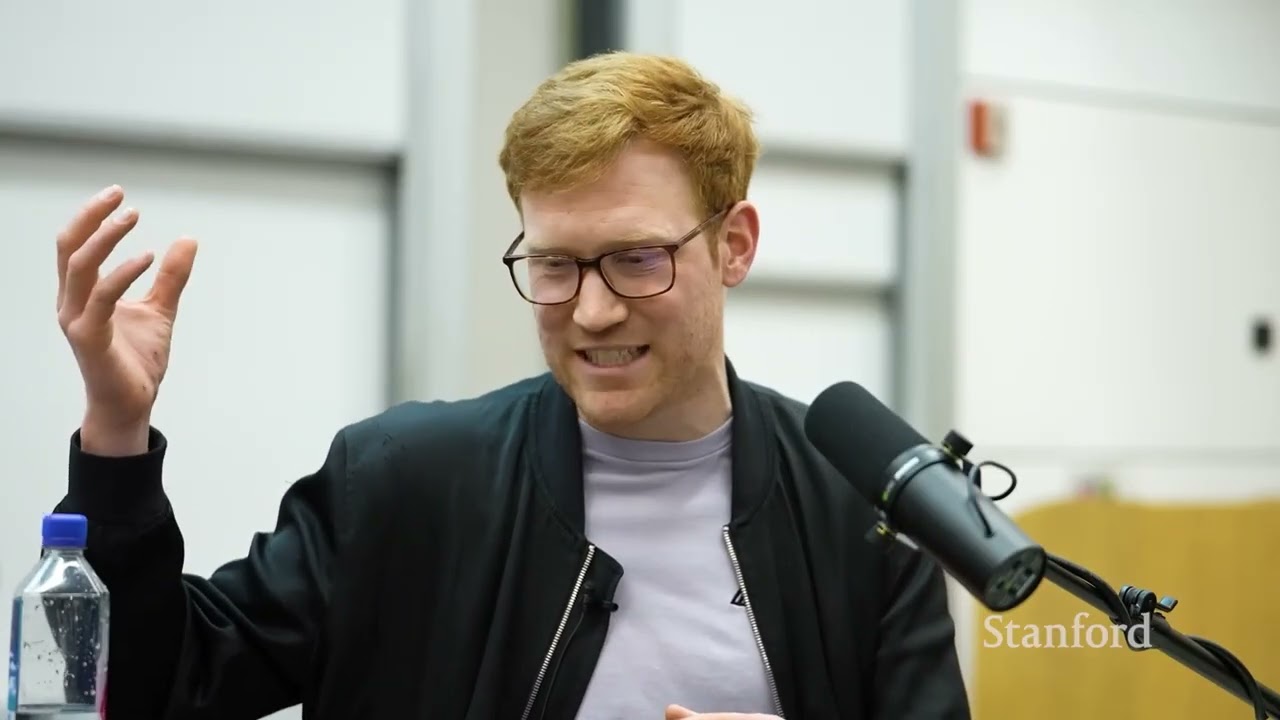
Stanford CS153 Frontier Systems | Mati Staniszewski from ElevenLabs on The Future of Voice Systems
For more information about Stanford's online Artificial Intelligence programs, visit: https://stanford.io/aiFollow along with the course schedule and syllabus, visit: https://cs153.stanford.edu/
In week two of CS153 ("AI Coachella"), Anjney Midha interviews Mati Staniszewski, founder and CEO of ElevenLabs, tracing the company’s origins from an early Discord text-to-speech bot to a fast-growing frontier audio and speech platform.
Mati explains ElevenLabs’ initial focus on solving AI dubbing inspired by Poland’s single-voice film narration, the shift to prioritizing emotional, natural-sounding text-to-speech for creators, and the evolution from cascaded pipelines (transcription, translation/LLM, and speech generation) toward real-time voice agents.
They discuss tradeoffs between cascaded versus fused multimodal systems, efforts to detect and convey emotion, safety and voice authentication limits, on-device model deployment, collaboration with teams like Sesame, and business lessons on PLG plus enterprise deployment, team structure, pricing from customer value, and growth to over $430M revenue with ~450 employees.
Guest Speaker:
Mati Staniszewski is the CEO and co-founder of ElevenLabs, the AI voice/audio platform. Born in 1995 in a town outside Warsaw, Poland, he attended Copernicus Bilingual High School in Warsaw before earning a degree in mathematics from Imperial College London. While at Imperial, he organized Mathscon, a UK student-led mathematics conference. His earlier career included roles at Opera Software, BlackRock (where he worked in the Portfolio Analytics Group and helped launch the Aladdin Wealth platform), and Palantir Technologies (as a Deployment Strategist managing large-scale public- and private-sector implementations). In 2022, he co-founded ElevenLabs with his high school friend Piotr Dabkowski. He has raised hundreds of millions from investors, including Sequoia, Andreessen Horowitz, and Salesforce Ventures, with the company valued at $11 billion as of February 2026. He joined the board of Klarna in 2025 and was named to Forbes 30 Under 30 Europe in 2024 and TIME's 100 Most Influential People in AI in 2025.
Follow the playlist: https://youtube.com/playlist?list=PLoROMvodv4rN447WKQ5oz_YdYbS74M5IA&si=DOJ5amlyRdyMJBhG Receive SMS online on sms24.me
TubeReader video aggregator is a website that collects and organizes online videos from the YouTube source. Video aggregation is done for different purposes, and TubeReader take different approaches to achieve their purpose.
Our try to collect videos of high quality or interest for visitors to view; the collection may be made by editors or may be based on community votes.
Another method is to base the collection on those videos most viewed, either at the aggregator site or at various popular video hosting sites.
TubeReader site exists to allow users to collect their own sets of videos, for personal use as well as for browsing and viewing by others; TubeReader can develop online communities around video sharing.
Our site allow users to create a personalized video playlist, for personal use as well as for browsing and viewing by others.
@YouTubeReaderBot allows you to subscribe to Youtube channels.
By using @YouTubeReaderBot Bot you agree with YouTube Terms of Service.
Use the @YouTubeReaderBot telegram bot to be the first to be notified when new videos are released on your favorite channels.
Look for new videos or channels and share them with your friends.
You can start using our bot from this video, subscribe now to Stanford CS153 Frontier Systems | Mati Staniszewski from ElevenLabs on The Future of Voice Systems
What is YouTube?
YouTube is a free video sharing website that makes it easy to watch online videos. You can even create and upload your own videos to share with others. Originally created in 2005, YouTube is now one of the most popular sites on the Web, with visitors watching around 6 billion hours of video every month.